
News
Seminar on “Strengthening Confidence in the Healthcare System in Bangladesh: A Strategy for Quality Assurance”
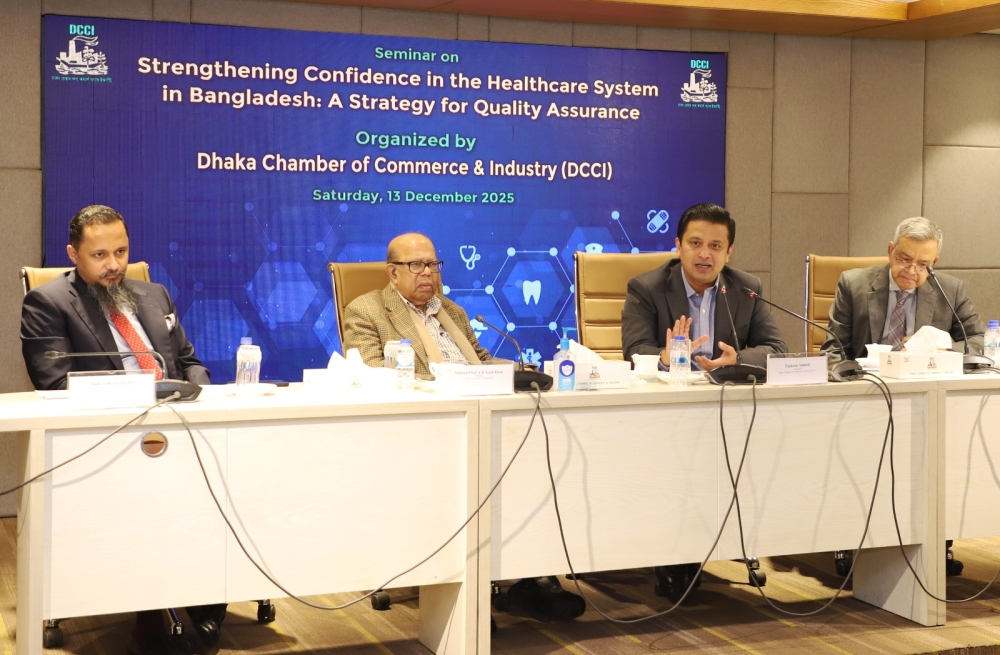
Bangladesh’s healthcare sector has failed to achieve the desired level of development due to only 1% of GDP allocation, inadequate infrastructure, lagging adoption of new technologies, shortage of skilled human resources, high cost of healthcare services, management inefficiencies and weak monitoring of existing policies in this sector. Enhancing coordination between the public and private sectors alongside greater public engagement, is essential for the health sector’s overall improvement. Speakers made these observations at a seminar on “Strengthening Confidence in the Healthcare System in Bangladesh: A Strategy for Quality Assurance” organized by the Dhaka Chamber of Commerce & Industry (DCCI) held on 13 December 2025 at the DCCI Auditorium. National Prof. A K Azad Khan, President, Diabetic Association of Bangladesh, graced the occasion as the Chief Guest.
In his welcome remarks, DCCI President Taskeen Ahmed said that structural gaps persist in ensuring quality and patient-friendly healthcare services in the country. He highlighted disparities in service quality between the public and private sector owned hospitals, shortages of skilled manpower, the widespread increase in unauthorized clinics and pharmacies, inaccurate diagnostic reports, counterfeit medicines, weak regulatory oversight, limited use of modern technologies and most importantly lack of effective implementation of existing laws continue to erode public health security and trust. He noted that due to the absence of an effective health insurance mechanism, individuals have to bear nearly 74% of total healthcare expenditure on their own, posing serious financial risks for low- and middle-income groups. To ensure a sustainable healthcare system, he stressed the need for foreign investment, strengthened public-private partnerships, adoption of modern medical technologies, development of skilled professionals in nursing, laboratory sciences and health management, effective policy implementation and efficient management. He also emphasized establishing a strong health regulatory framework to ensure a health-friendly environment for people at all levels.
National Prof. A K Azad Khan, President, Diabetic Association of Bangladesh acknowledged that there have been notable achievements in Bangladesh’s healthcare sector but desired quality standards have not achieved yet. To attain the desired development, he called for stronger government involvement. He observed that healthcare quality in Bangladesh lags behind developed countries and even neighboring countries. Though establishing universal health care may not be feasible at present, he stressed on implementing primary healthcare. Along with the overall management development, decentralization is also crucial for the betterment of the health sector. He also highlighted the expansion of digital healthcare to improve rural access, the modernization of medical education curricula and creating a conducive environment for medical research.
In his keynote speech Malik Talha Ismail Bari, Managing Director & CEO, United Hospital Limited and Former Senior Vice President, DCCI stated that the government’s per capita annual health expenditure is BDT 1,070, and according to the World Health Organization, nearly 49% of the population is deprived of quality healthcare services. He added that while the sector’s current market size is approximately USD 14 billion, it is projected to reach USD 23 billion by 2033. He identified low budget allocation and inefficient management, urban–rural disparities in healthcare access, gaps in service quality and public trust, shortages of skilled health professionals, rising healthcare costs, inadequate infrastructure and weak regulatory systems as the major challenges facing the sector. He further noted that a significant portion of the population seeks medical treatment abroad for better healthcare, resulting in an annual outflow of nearly USD 5 billion. To improve the current situation, he emphasized the need to attract both local and foreign investment, simplify access to financing, strengthen infrastructure, ensure the adoption of modern technologies, enhance human resource capacity, and update existing policies to make them more responsive to current needs.
Professor Syed Atiqul Haq, Chief Consultant, Green Life Center for Rheumatic Care and Research emphasized that since most citizens rely on public hospitals, there is no alternative to ensuring the highest quality standards in government healthcare facilities, along with transparency and accountability at all levels.
Priti Chakraborty, Chairman, Universal Medical College & Hospital said that the domestic healthcare market is steadily expanding and restoring trust in this sector will require concerted efforts from the government as well as the private sector. Besides, there is also scope for using the Public Private Partnership (PPP) model to further develop this sector. She noted that foreign students enrolled in Bangladesh’s medical education institutions spend around two thousand crore annually, while many Bangladeshis still seek medical treatment abroad, underscoring the need for careful and strategic reflection on this issue.
Dr. Shafiun Nahin Shimul, Professor and Director, Institute of Health Economics, University of Dhaka said negative approach made by us is the cause of reducing of confidence in the healthcare sector. We need to ensure behavioral change to build confidence. We have to strengthen the overall medical system, if we able to give primary medical services to our own people, patients will not go outside for treatment. Digitalization, technology use will increase patients’ confidence.
Dr. Md. Zakir Hossain, Secretary General, Bangladesh Association of Pharmaceutical Industries stated that 97% of medicines are produced locally and exported to 160 countries, reflecting confidence in Bangladesh’s pharmaceutical products. However, he highlighted that despite having a health policy since 2011, no update has been made over the past 14 years. Besides, the sector lacks an integrated policy framework which is hindering the overall development of this sector. He called for long-term sustainable policies, stronger public–private coordination, and a comprehensive health financing strategy.
Dr. Md. Mustafizur Rahman, Senior Scientist, Infectious Diseases Division, icddr,b shared that icddr,b provides diarrheal care to nearly 300,000 patients annually, and its model could be replicated elsewhere. He also mentioned ongoing work on cancer diagnostic genomics and expressed optimism that a dengue vaccine could be available within the next two years.
Dr. Fida Mehran, Health Systems Specialist, UNICEF Bangladesh and Dr. Murad Sultan, National Professional Officer of Patient Safety and Blood Safety, World Health Organization (WHO), Bangladesh both emphasized that effective public-private collaboration, restoring trust in domestic healthcare services, reforming service delivery processes, and enforcing appropriate policies are critical.
In the open floor discussion session, DCCI Senior Vice President Haider Ahmed Khan, FCA, former Director Alhaj Mohammad Sarfuddin, Professor Dr. Billal Hossain of the University of Dhaka, and Ishtiaq Ahmed, Proprietor of Mega Health Care, also spoke on the occasion.
DCCI Vice President Md. Salem Sulaiman, members of the Board of Directors, government and private sectors stakeholders were also present at the seminar.
Published on: 2025-12-13