
News
Seminar on “Backward Linkage Development of the Chemical-Dependent Key Export-Oriented Industries
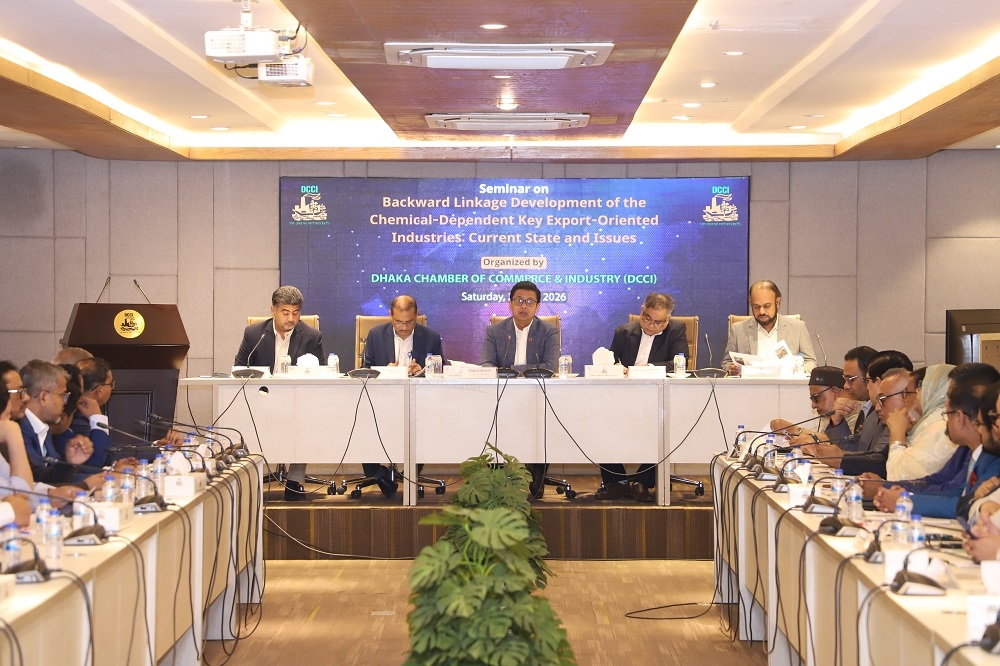
Despite Bangladesh's local chemical market exceeding USD 6 billion, heavy reliance on imports, inadequate and uninterrupted energy supply for industries, higher tariff rates, complex and lengthy licensing procedures and limitations in logistics infrastructure have hindered the expected development of the country's chemical backward linkage sector. These observations were highlighted by the stakeholders at a seminar on ‘Backward Linkage Development of the Chemical-Dependent Key Export-Oriented Industries: Current State and Issues’ organized by Dhaka Chamber of Commerce & Industry (DCCI) on July 25, 2026 at the DCCI auditorium. Md. Salim Ullah, Director General, Bangladesh Institute of Management (BIM) and Abul Fatah Md. Baligur Rahman, Member (Development), Bangladesh Council of Scientific and Industrial Research (BCSIR) attended the event as Special Guests.
In his welcome address, DCCI President Taskeen Ahmed stated that the export competitiveness of Bangladesh's RMG, textiles, leather and pharmaceutical industries depends significantly on a competitive supply chain of chemical products. However, he noted that the country's industrial growth continues to be hampered by heavy reliance on imported dyes, chemicals, specialized industrial raw materials, along with tariff complexities, lengthy environmental clearance procedures and logistical bottlenecks. He emphasized that developing a comprehensive roadmap to strengthen the chemical backward linkage industry is no longer optional but a strategic necessity to safeguard the future of Bangladesh's export sector.
Md. Salim Ullah, Director General, Bangladesh Institute of Management (BIM) mentioned that the government is currently reforming the National Industrial Policy. He suggested that the private sector should decide whether the development of the chemical backward linkage industry requires a separate policy or whether the necessary reforms should be incorporated as a dedicated chapter in the existing industrial policy. He also stressed that the development of backward linkage industries for chemical-dependent key export-oriented sectors is crucial for the advancement of Bangladesh's industrialization. The BIM Director General called for stronger public and private sector collaboration to develop a skilled workforce to support the country's overall economic growth.
Abul Fatah Md. Baligur Rahman, Member (Development), Bangladesh Council of Scientific and Industrial Research (BCSIR), underscored the need to bridge the gap between industry and academia to accelerate Bangladesh's economic growth. He encouraged industrial entrepreneurs to utilize research outcomes and products developed by BCSIR. By mobilizing local resources, how we can add significant value to the export products and establish competitive import-substitute industries BCSIR is rigorously working toward that goal, he added. Referring to the light engineering sector, he noted that Bangladesh has a market worth approximately BDT 5 thousand crore, but realizing its full potential will require uninterrupted electricity and energy supply alongside appropriate policy support.
In his keynote presentation Mr. Asif Rabbani, Managing Director, SR Chemical Industries Ltd, SR Group Ltd. stated that Bangladesh's domestic chemical market is currently valued at USD 6–8 billion, growing annually at 10–15 percent. In FY2025, Bangladesh imported approximately USD 6.2 billion worth of chemicals, the majority of which were used in the RMG, pharmaceutical, and leather industries. He identified logistics constraints, high tariff rates, inadequate infrastructure and the lack of an efficient supply chain as major barriers to the sector's development. He stressed the need for both modernization of relevant policies and enhancement of domestic industrial capabilities.
Among the designated discussants were Md. Ziaul Haque, Additional Director General (Current Charge), Department of Environment; Md. Shaheen Ahamed, Chairman, Bangladesh Tanners Association; M. Mosaddek Hossain, Senior Vice President, Bangladesh Association of Pharmaceutical lndustries (BAPI); Dr. Md. Akter Hossain, Director, Directorate General of Drug Administration (DGDA); Dr. Yeasmin Nahar Jolly, Director & Chief Scientific Officer, Atomic Energy Center, Dhaka, Bangladesh Atomic Energy Commission; KSM Mostafizur Rahman, President, Bangladesh Agro-Chemical Manufacturers Association (BAMA); Suraiya Sultana, Second Secretary: (Customs: Export & Bond), NBR; Sheikh H M Mustafiz, Director, BGMEA and Founder & Managing Director, Cute Dress Industry Ltd.; Md. Moniruzzaman, Director, BKMEA & Chairman, Badon Fashion Ltd.; and Md. Majaharul Islam Sumon, Country Manager, DyStar Singapore Pte Ltd, Bangladesh.
Md. Moniruzzaman, Director, BKMEA & Chairman, Badon Fashion Ltd. stated that the successful development of backward linkage industries in the RMG sector through supportive government policies could serve as a model for the chemical industry, leading to greater investment and employment.
Sheikh H M Mustafiz, Director, BGMEA emphasized that uninterrupted energy supply, supportive policy measures, adherence to international quality standards in chemical production and the establishment of specialized industrial zones are essential for the sector's growth.
M. Mosaddek Hossain, Senior Vice President, BAPI highlighted the importance of developing a stronger chemical ecosystem while strengthening research and skilled manpower.
Dr. Md. Akter Hossain, Director, DGDA noted that entrepreneurs are falling behind due to delays in implementing necessary improvements in the API Industrial Park.
KSM Mostafizur Rahman, President, BAMA pointed out that high import duties on raw materials continue to impede the agro-chemical industry, making policy support indispensable.
Md. Shaheen Ahamed, Chairman, Bangladesh Tanners Association observed that the leather sector remains heavily dependent on imported chemicals and urged a reduction in import-stage duties.
Suraiya Sultana, Second Secretary: (Customs: Export & Bond), NBR informed participants that tariff rates are being gradually reduced to encourage local chemical production and that the bonded warehouse licensing process has been fully digitized, which will significantly reduce the difficulties faced by entrepreneurs.
Md. Ziaul Haque, Additional Director General (Current Charge), Department of Environment cautioned that while industrial growth is important, chemical management must be handled responsibly to prevent adverse impacts on public health and the environment. He urged all stakeholders to remain vigilant regarding the import and use of hazardous chemicals.
During the open floor discussion, former Senior Vice President of DCCI Alhaj Abdus Salam and DCCI Member M. S. Siddiqui also shared their views.
DCCI Senior Vice President Razeev H Chowdhury, Vice President Md. Salem Sulaiman, members of the Board of Directors, representatives from relevant public and private sector organizations were also present on the occasion.
Published on: 2026-07-25